
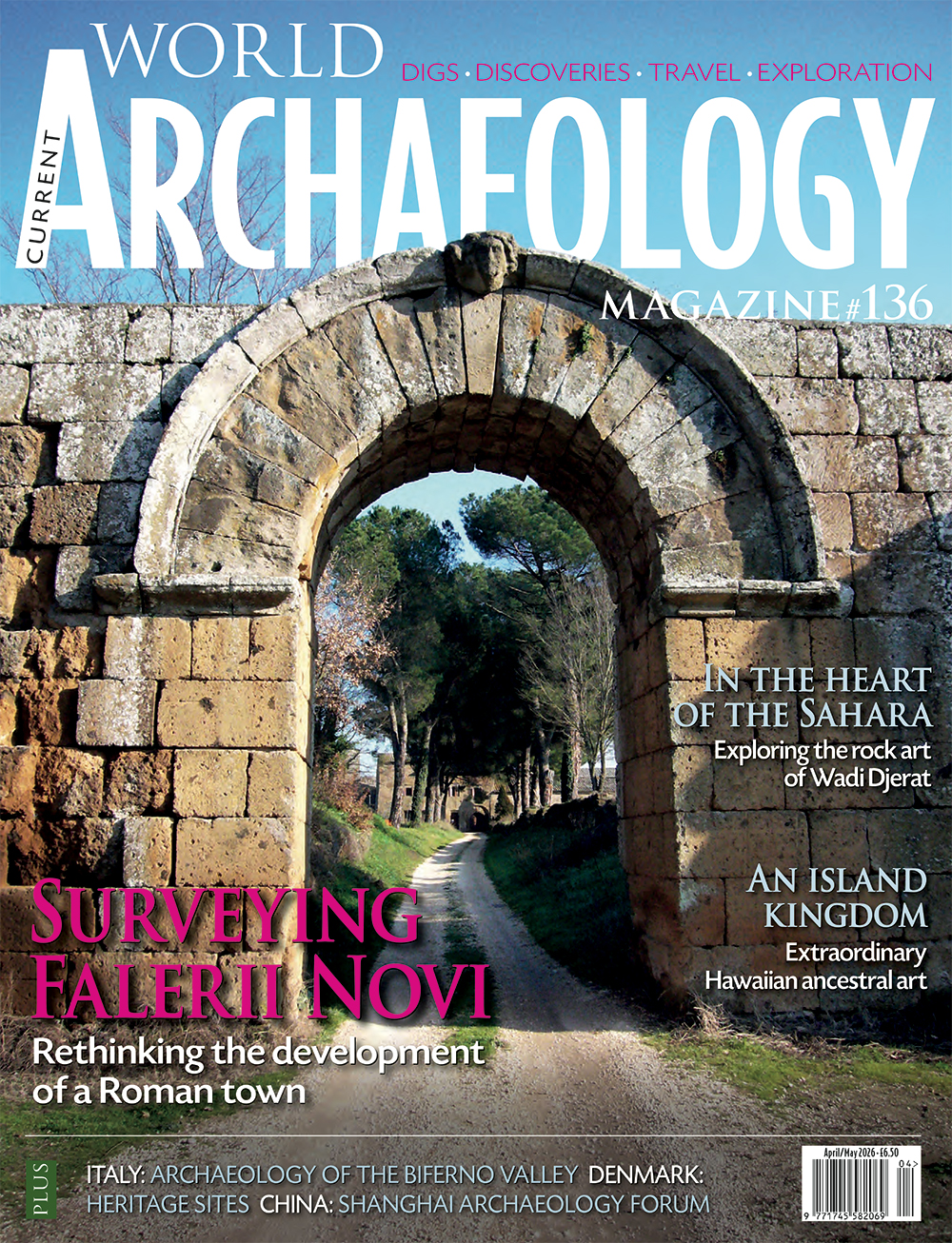
There can be a certain familiarity to Roman towns. During the heyday of the Empire, such settlements were essential for administering conquered territory. By then, there was also a standard range of public buildings that towns might be expected to contain, including a forum, temples, baths, and so on. But what about the formative era of Roman urbanism in the 4th and 3rd centuries BC? Recent survey work at Falerii Novi, an ancient town about 44km north of Rome, has shed fascinating light on its development. The results show the importance of local influences as Roman urbanism took shape.
It is the impact of a capricious environment that is in evidence among the remarkable rock art of Wadi Djerat, in the Sahara Desert. Despite modern perceptions of this as an arid and inhospitable expanse, it was once home to lakes, rivers, and grass savannah. Some of the humans who witnessed this world created images of the animals roaming these lands. As the climate grew drier, so too the imagery evolved, presenting an evocative glimpse of a changing world.
Change was certainly under way in Hawai’i in the 18th and 19th centuries. This was an era when the archipelago was unified into a single kingdom by the Hawaiian king Kamehameha I, while growing numbers of Western explorers arrived on its shores. Both Kamehameha I and his son appreciated that sovereignty in this new age would depend on establishing overseas alliances, prompting some remarkable maritime journeys.
In our travel section, Richard Hodges revisits the Biferno valley, Italy, where he excavated in the 1970s, and introduces the archaeology of a classic Mediterranean valley. Meanwhile, dipping into the heritage of Denmark reveals a wealth of sites to enjoy.
Finally, I offer a warm welcome to Manuel Fernández-Götz, who will be joining Rubina Raja in the popular column examining ancient urbanism. We’re delighted to have him as a regular contributor.