
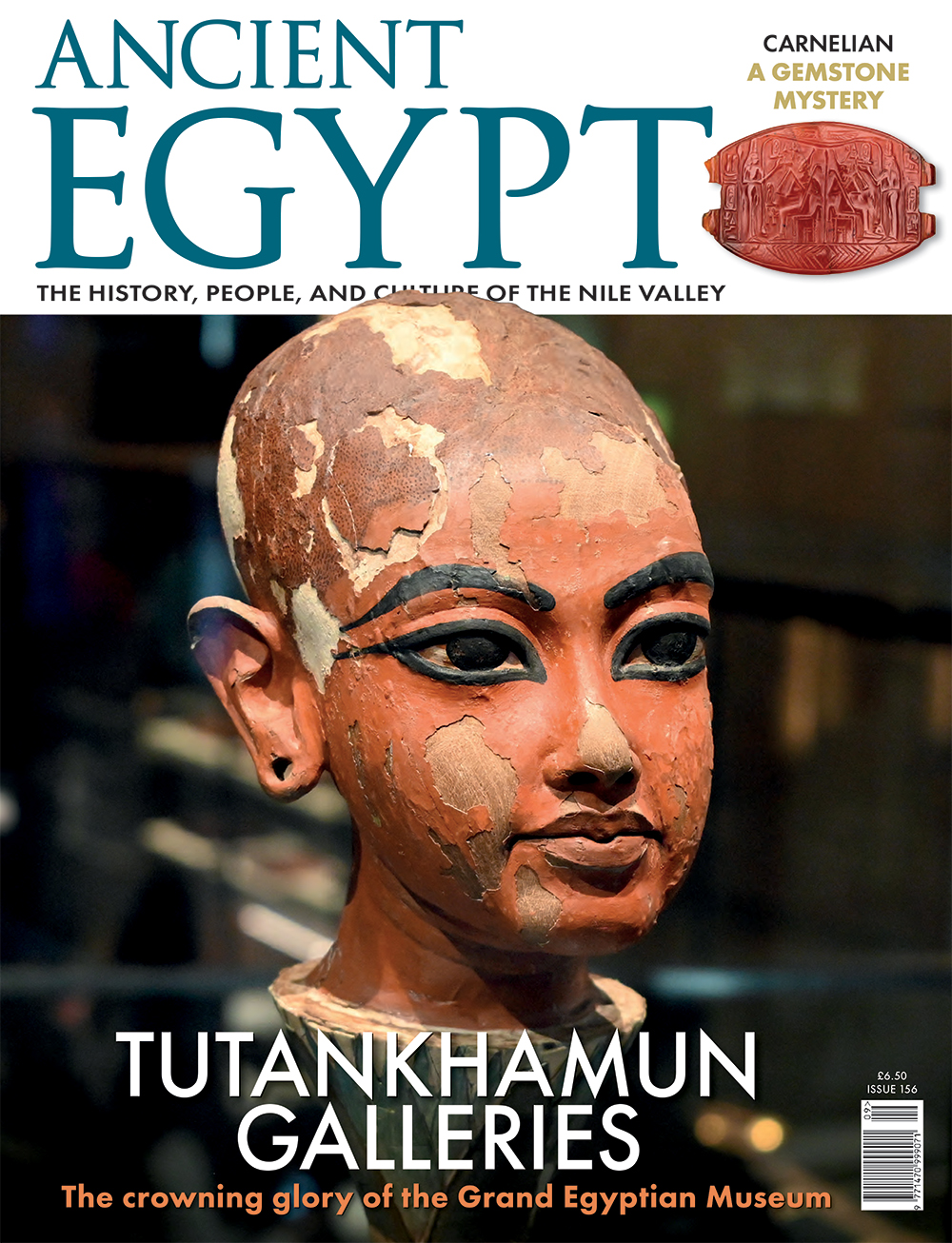
The Grand Egyptian Museum at Giza is reputed to be the largest IL in the world dedicated to a single ancient civilisation. In practice, it is so big that only a tiny fraction of its collection can be viewed in one day. Geoffrey Lenox-Smith has already described in AE 138 and AE 148 earlier visits that he made before the museum was fully open. In this issue, he describes the artefacts in the newly opened galleries, including the Tutankhamun treasures and the Khufu barques.
Several other articles in this issue follow on from previous ones.
Hilary Wilson continues her explanation of the connection between bread and ancient Egyptian economics – where grain took the place of money. James A Harrell, who described the importance of purple gemstones in AE 153, now investigates the mystery surrounding the source of a popular orange stone: carnelian. Ira Rampil continues his study of the medical papyri by looking at physical and magical interventions intended to offer pain relief.
Robert Frost’s biography of Sir John Gardner Wilkinson tells how he was the foremost Egyptologist in Regency and much of Victorian Britain, whose accurate transcription of hieroglyphic inscriptions was particularly valuable.
The ability to read and write was for the most part limited to the male priesthood and professional scribes. But it must also have been a necessary skill for some women, as Simone Petacchi tells us.
In earlier editions of AE, Andrew Fulton brought to our attention two hieroglyphic texts: the Book of the Heavenly Cow, recorded on the walls of several royal tombs, and Ani’s Book of the Dead, now in the British Museum. Many key texts were recorded in hieroglyphs on the walls and columns of tombs in the Valley of the Kings, and one of them, the Litany of Ra, is the subject of another article by Andrew in this issue. Ancient Egyptian religion was hugely complex, with hundreds of deities, but in the New Kingdom one god was supreme: the sun god Ra. However, Ra had many manifestations, and the Litany of Ra lists 75 of them. Some are still shrouded in mystery, but those whose meaning is understood are described in Andrew’s article.