
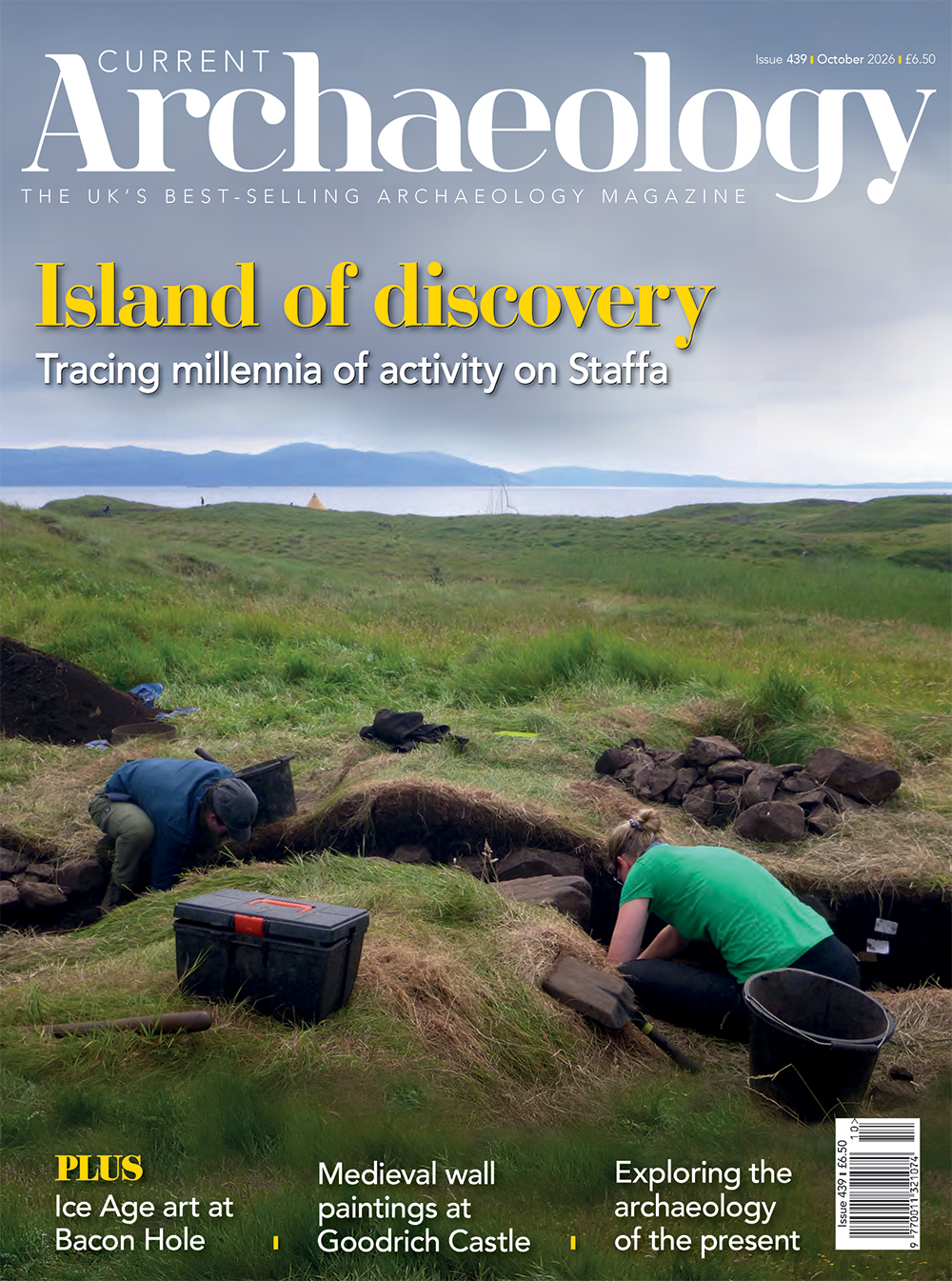
This year marks the 40th anniversary of the island of Staffa coming into the care of the National Trust for Scotland. Famed for its dramatic cliffs, caves, and black basalt columns, this picturesque portion of the Inner Hebrides has been a subject of scientific and artistic fascination – and a popular tourist destination – for centuries. Recent fieldwork has added to this picture, uncovering evidence of repeated visits, cultivation, and occupation stretching back to the post-medieval period, as well as unexpected echoes of even earlier activity dating to the Bronze Age, as our cover feature reports.
One of Staffa’s most intriguing aspects is the historic graffiti that has been recorded on the walls of Fingal’s Cave – and our second feature also highlights significant markings found within a cave, this time at Bacon Hole on the Gower Peninsula. There, a cluster of red lines were first reported as prehistoric paintings in 1912, but this interpretation proved controversial, sparking decades of debate and doubt. Can modern scientific investigations set the record straight?
Our next article examines British cemeteries, exploring how these peaceful places were influenced by historical, artistic, architectural, and literary interests, as well as by innovations in garden design. With many such sites now in a state of decline, how can we safeguard their legacy?
The articles above are mostly concerned with the distant past, or events on the cusp of living memory – but in our fourth feature we ask what can be learned by applying archaeological techniques to the present.
We end with an excursion to Goodrich Castle in Herefordshire, where recent conservation work has revealed traces of medieval wall-paintings showing that its chapel was much more elaborately decorated than previously thought.