
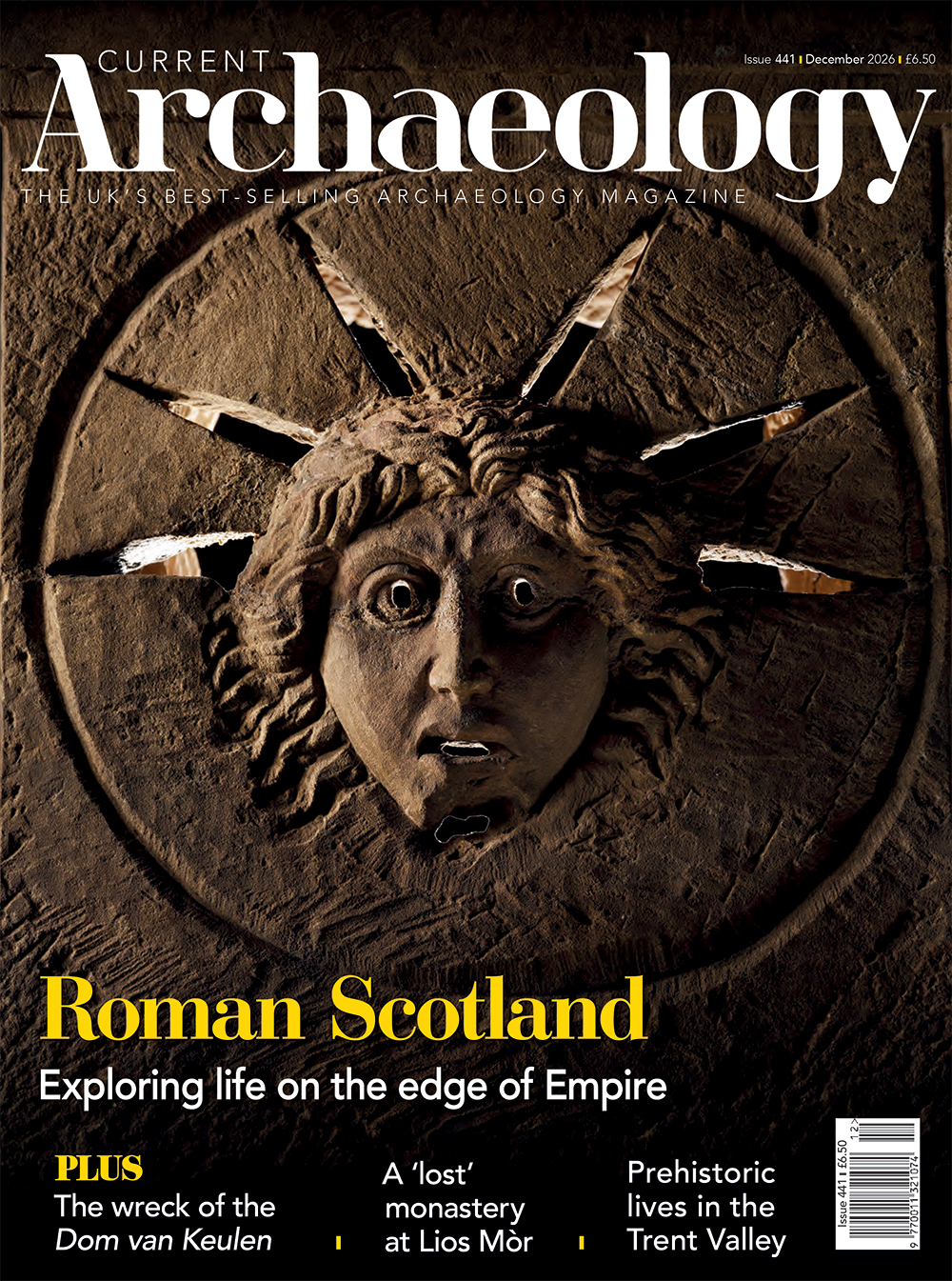
The Roman army tried to conquer Scotland three times. Our cover feature examines the experiences of soldiers in the frontier zone, the civilian communities that grew up around their forts, and the local people who called these lands home.
In the centuries immediately after Roman occupation ended in Britain, the early medieval church helped to shape a new cultural and political landscape. The monastery of Lios Mòr in the Inner Hebrides is mentioned in historical sources as an influential religious centre, but little archaeological evidence had been found to pin down its location – until now. Our second article reports on tantalising traces uncovered by a community-led excavation.
From buried clues to sunken secrets, we then dive beneath the waters of Devon’s Salcombe Bay to learn how dogged research has revealed the identity of a shipwreck first discovered more than 30 years ago, and what this work has revealed about its unusual cargo, life on board a 17th-century ship, and far-reaching trade connections.
Returning to the subject of the Roman invasion, our fourth feature offers a springboard to discuss these famous events from a thought-provoking new perspective. Archaeological and genetic research has shed intriguing light on the status of women in Iron Age Britain, and Roman writers attest to the existence of two female rulers, Boudica and Cartimandua. Here, Miles Russell makes the case for adding a third name to the list, and we consider what this reinterpretation might add to our understanding of the political context and power dynamics surrounding the conquest.
Our final article takes a wider view of the past, exploring the landscape of the Trent Valley and the ways in which it and the activities of its inhabitants have evolved and intertwined throughout prehistory.