
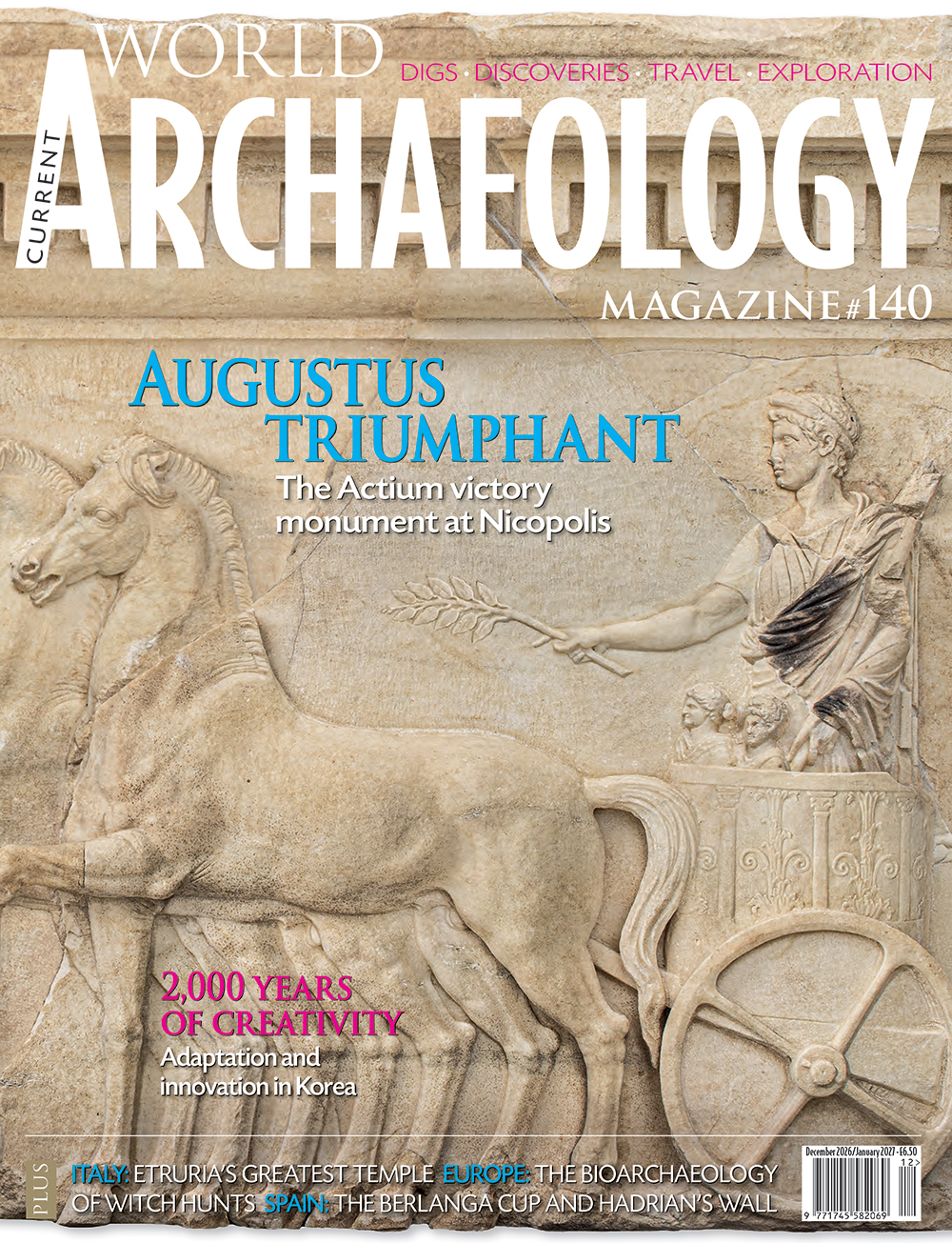
On 2 September 31BC, the fate of Rome was decided when the naval forces of the future Augustus clashed with those of Mark Antony and Cleopatra at the Battle of Actium. Augustus’ victory set him on course to become the first Roman emperor, while the place where he pitched his tent the night before the fighting was earmarked for a spectacular victory monument. This became the first in a notable set of grandiose Augustan propaganda works. The publication of a remarkable series of excavation campaigns at the site, by Dr Konstantinos Zachos, now allows us to understand in detail Augustus’ bold vision, architecturally and sculpturally, of how to commemorate for all time his landmark victory.
In medieval Europe, documents addressing the punishment of people accused of witchcraft framed the treatment of the condemned in terms of a controlled act of purification. Bioarchaeological assessment of potential victims of these witch hunts, however, is pointing to a different reality, where the punishments inflicted on these individuals could continue after death.
The location of the Korean peninsula has long aided both the reception and transmission of ideas. An exhibition at the British Museum is currently following this story across more than 2,000 years, showcasing how Korean artisans excelled at innovating new styles. Their handiwork also sheds light on the succession of states that developed on the peninsula.
In Spain, the discovery of fragments of a small bronze and enamel cup is raising questions about the connections between an area of ancient Celtiberia and Britain. The cup bears text naming a group of forts on Hadrian’s Wall, while its vibrant enamel decoration may incorporate a stylised depiction of this Roman frontier system. We examine how and why this cup travelled almost 2,000km from the Wall to its findspot.
Finally, in our travel section, Richard Hodges visits Etruria’s greatest temple: the Queen’s Altar in Italy. Decades of excavations allow us to appreciate how this extraordinary edifice developed over the centuries.