
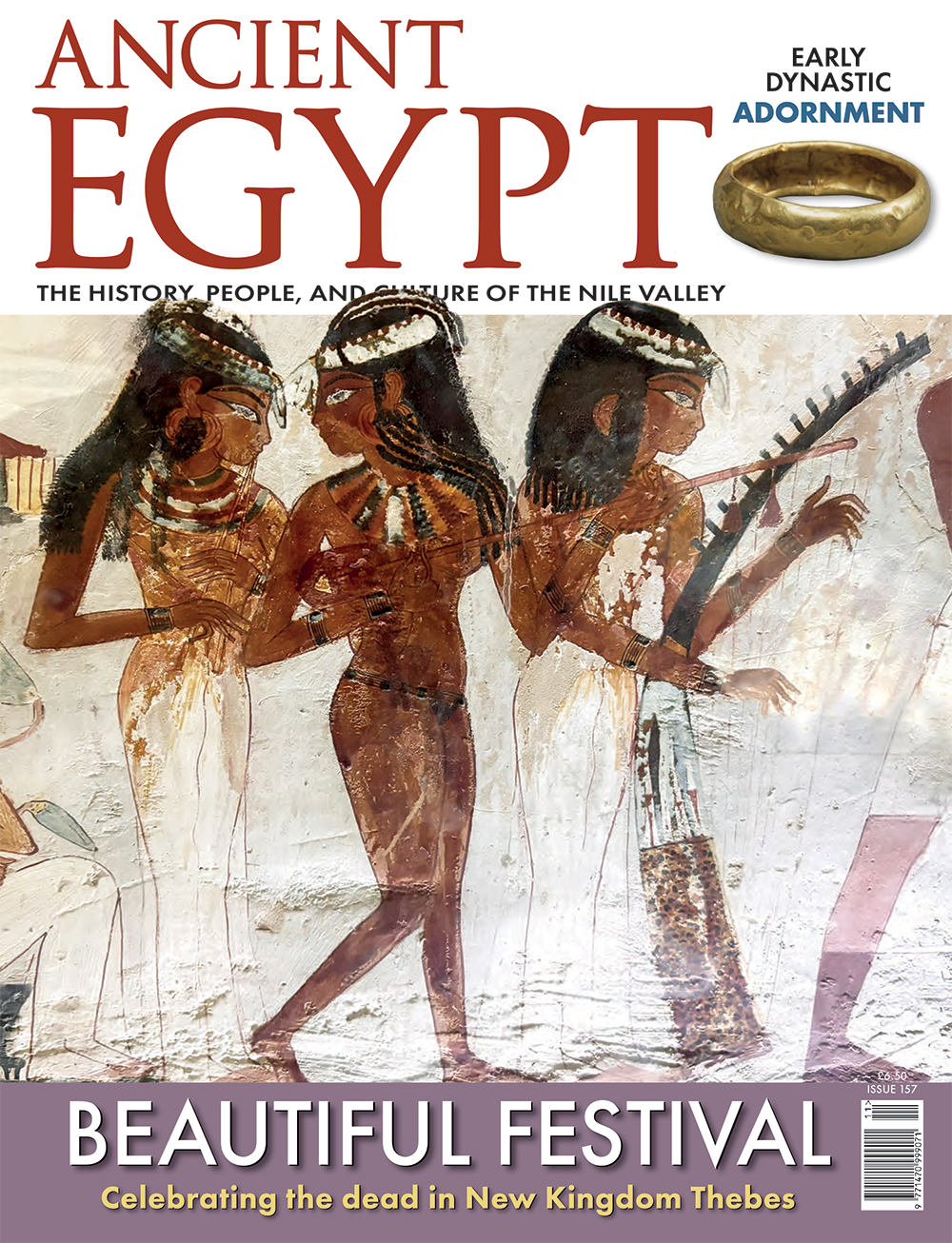
A common feature of most religions seems to be an annual festival in which participants are encouraged to indulge in food and drink and generally have a party with family and friends. As we approach the Christmas season, this may be an appropriate time to find out how the ancient residents of the Luxor area celebrated the annual Beautiful Festival of the Western Valley. In this issue, Katherine Slinger makes us onlookers at spectacular processions from the temples of Karnak and Luxor across the Nile to the West Bank mortuary temples. She describes private parties in the courtyards of family tombs, where music, dancing, and intoxication were the order of the day.
Elite guests at these parties would wear their best clothing and jewellery, perhaps even some family heirlooms, like the items described by Barbara Boczar in her article on the materials used in creating personal adornment in the earliest periods. On their feet, they would wear sandals – Hilary Wilson describes the different types and their symbolism.
The scenes on tomb and temple walls that give us so much information about the Beautiful Festival are relatively easy to access and copy, but not all inscriptions are as conveniently located. Ricardo A Caminos spent much of his career perched precariously at the top of flimsy ladders as he recorded inscriptions high up on rock faces. Carl Graves celebrates the huge contribution to Egyptology made by Caminos.
Even for the elite, life in ancient Egypt was a precarious business, from birth ‘on bricks’ as described by W Benson Harer, and in medieval times it could be snuffed out in conflicts such as the Fifth Crusade, as Thomas Smith recounts.
Two very different archaeological sites are described in this issue: Fort Rashid in the Delta, the place where the Rosetta Stone was discovered, and Ain Khadra, a tiny oasis in the Western Desert. The fort is described by Geoffrey Lenox-Smith, who was able to identify the scant remains of earlier structures imbedded in its walls, while Amir Ebrahim Elkorashy interprets the significance of the few remains that surround the oasis spring.