
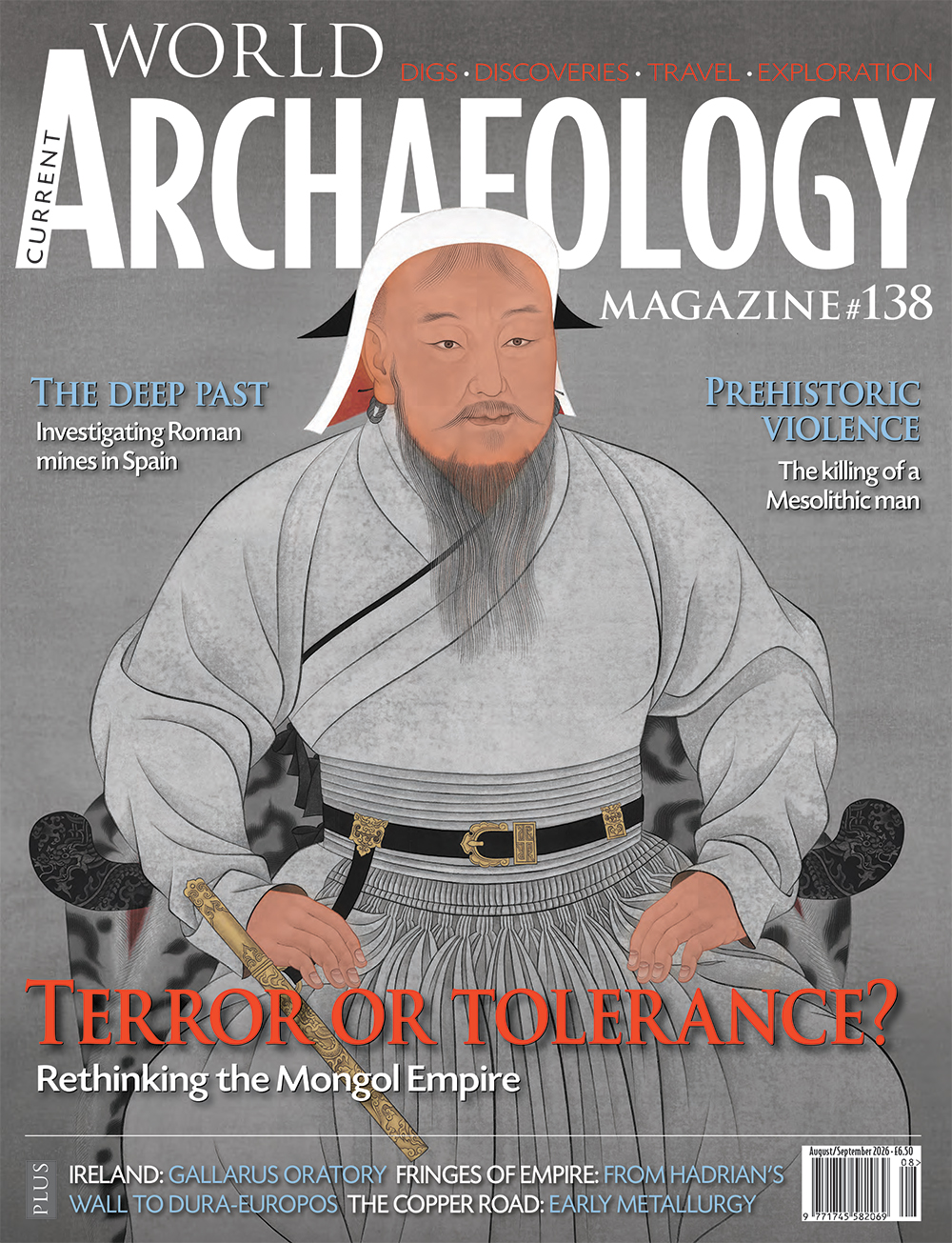
In the 13th century, the Mongols carved out the largest contiguous land empire that the world has ever seen. At its height, under a million of these steppe nomads successfully controlled hundreds of millions of subjects. How did they do it? One answer lies in the Mongols’ status as fearsome warriors with a reputation for brutality. Focusing in on the violence visited on enemies, though, obscures another side to their empire. Western travellers report being stunned by the religious tolerance on display, while support for arts and crafts promoted the emergence of beautiful new styles. As an exhibition dedicated to the Mongols arrives at the Royal Armouries, we take a fresh look at their empire.
The Mesolithic period is often seen as a time of peace rather than human conflict. A discovery in Sweden, though, illustrates how the hunter-gather bands who roamed this region in search of natural resources could also deal in violence. Examining the circumstances that led to the killing of a 25– to 35-year-old male has prompted a search for other possible victims.
One of the natural resources that the Romans prized in Spain was a form of translucent rock that found favour among the elite as window panes. Extracting this valuable commodity brought wealth to the region, and left an extraordinary archaeological legacy. Investigating the labyrinth of Roman mines concealed beneath the surface is shedding light on the achievements of ancient workers toiling deep underground.
In our travel section, Richard Hodges has also been experiencing a marvel in stone: Gallarus Oratory. This magnificent corbelled church in Ireland is generally believed to date to the 8th century, but the building technique it perfected has a pedigree that stretches back far earlier into the prehistoric period.
Finally, Rubina Raja leads us from Dura-Europos and Palmyra in Syria to Hadrian’s Wall, as she explores the fringes of the Roman Empire, and examines what makes these regions special.