
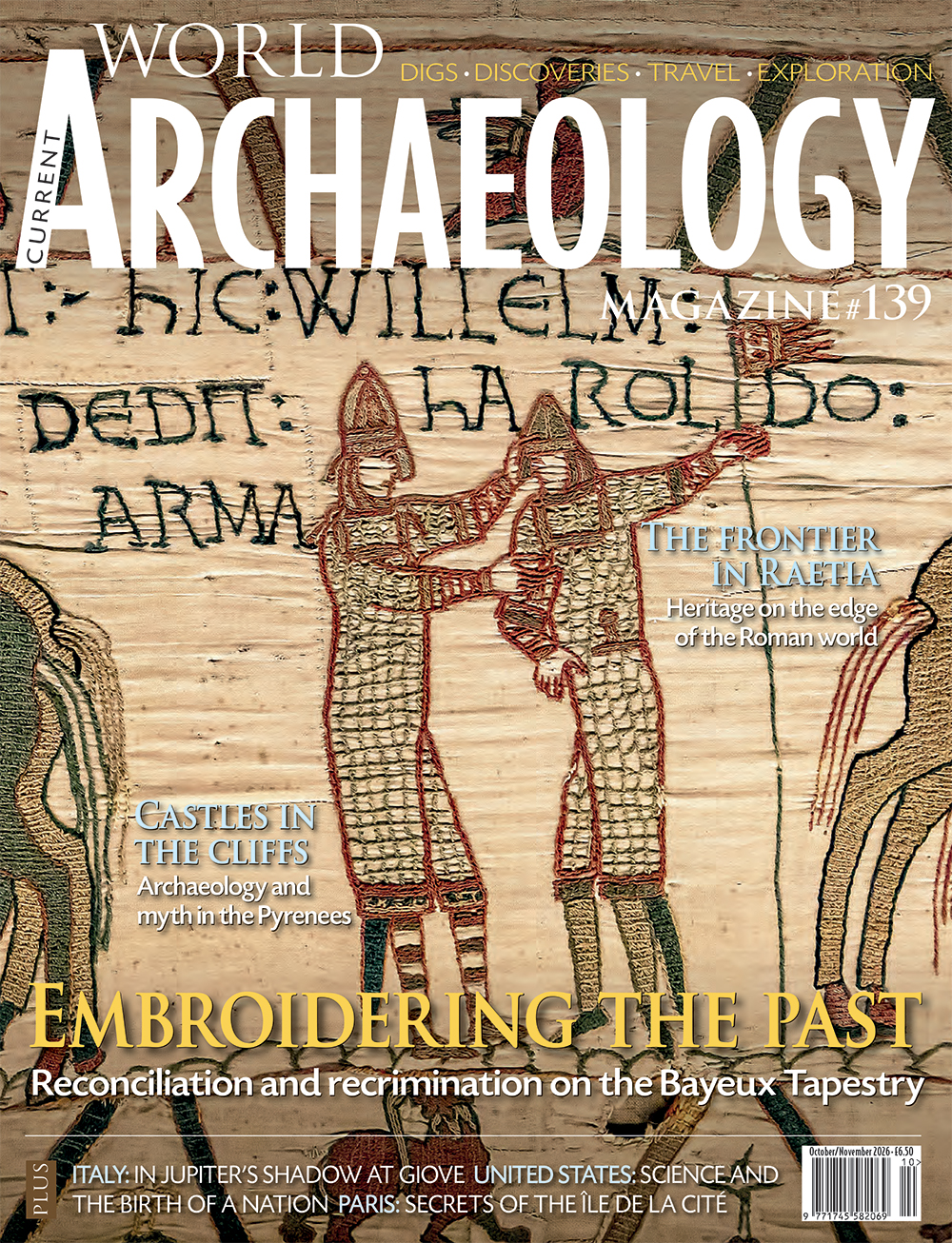
On 14 October 1066, King Harold Godwinson fell at the Battle of Hastings, and England changed forever. The Bayeux Tapestry leads us, step by step, through the events that brought this change about. It is a dazzling tale of rivalry and camaraderie, oaths and omens, banquets and battles. The embroidered images bring the events of 960 years ago to life with startling power. Even though the Bayeux Tapestry was most likely created after Norman control of England was secure in the 1070s, it seems to take a surprisingly even-handed approach to the actions of both conquerors and conquered. In our cover feature, the sublime British Museum exhibition provides an opportunity to ponder why the Bayeux Tapestry was made, and what messages it was intended to impart.
The intentions behind a remarkable group of cliff castles on the road from Toulouse to Barcelona have also long excited imaginations. They were once seen as hideouts for the survivors of a 13th-century massacre, but more recent study has emphasised their value as highly visible statements of power. Indeed, they made one local count confident enough to defy the King of France.
Conflict could also be a feature of Roman frontier zones. The fortifications marking the edge of Raetia, in modern Germany, ran both overland and along the banks of the Danube. While these stretches had a different character, they are home to heritage that provides a vivid sense of life on the edge of the Roman world.
At the Science Museum, the role that scientific knowledge and its practical applications had in the emergence of the United States of America is under the microscope. The results show how new ideas and technologies shaped the land and peoples during this transformative period. At the same time, applying these concepts and methods in North America had a profound impact on how science itself developed.
Finally, in our travel section Richard Hodges examines the archaeology of Giove, a settlement in the Tiber valley that was once home to brickmakers who helped build ancient Rome.